London at Night: The Best Landmarks to See After Dark
There’s a version of London that most tourists never see. Not because it’s hidden — it’s right there, in exactly the same place as the daytime version. But after sunset, when the floodlights come on and the crowds thin out and the river turns black and reflective, the whole city shifts. It gets quieter. More dramatic. The buildings that felt busy and functional during the day become something else entirely when they’re lit against a dark sky.
If you’ve only seen London in daylight, you’ve seen half of it.
Big Ben and the Houses of Parliament
This is probably the single most impressive night view in London. The Elizabeth Tower and the Palace of Westminster are illuminated from the ground up, and the golden stone and Gothic detailing glow in a way that makes the building look almost unreal. The clock faces — bright white circles against the dark tower — are visible from miles away.
The best viewing spot is Westminster Bridge. Stand on the south side, lean against the railing and look north. You’ll have the illuminated Palace stretching out along the river to your left, the Elizabeth Tower directly ahead, and the dark water of the Thames reflecting everything back at you. On a still evening, the reflections are almost perfect.
The other brilliant angle is from the South Bank, near the London Eye. From here you see the full length of the Parliament building with the river in the foreground. It’s the view that ends up on postcards and it looks even better in real life than in photographs because your eyes can take in the full scale of it — something a camera lens struggles to capture.
Tower Bridge
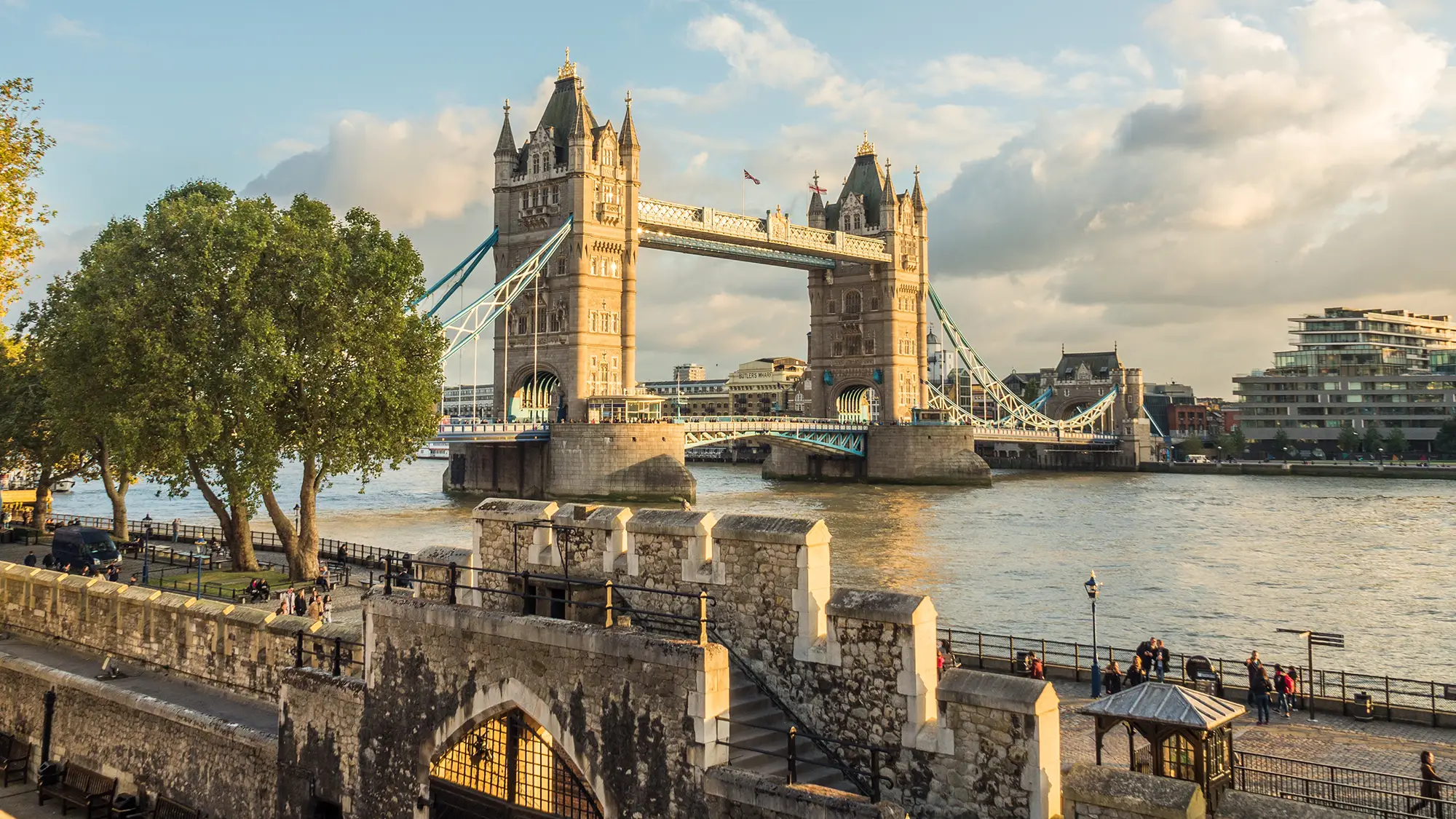
If Big Ben wins the award for most impressive single building at night, Tower Bridge takes the prize for the most photogenic overall scene. The bridge is lit in blue and white, the suspension chains are outlined in light, and the towers are illuminated from below in a way that emphasises the height and the Victorian Gothic detailing.
Walk along the south bank from London Bridge station towards Butler’s Wharf and you’ll hit the perfect viewing spot — about 200 metres east of the bridge, where the curve of the river gives you the full span with both towers visible. In summer, the restaurants along Shad Thames and Butler’s Wharf have outdoor terraces with this view. In winter, you’ll have the path more or less to yourself.
If the bridge lifts while you’re watching — it opens for river traffic around 800 times a year, including some evening lifts — the sight of those massive bascules rising with the towers lit behind them is genuinely spectacular. You can check the lift schedule on the Tower Bridge website. Our drivers keep an eye on it too.
St Paul’s Cathedral
Wren’s masterpiece looks good at any time of day, but at night — lit from below with the dome catching the light against a dark sky — it has a presence that’s hard to describe. The floodlighting picks out the Portland stone columns and the layers of the dome in a way that daylight flattens.
The view from the Millennium Bridge is the classic one. Walk to the middle of the bridge and look north. St Paul’s fills the frame, perfectly centred at the end of Peter’s Hill. It’s the same view the Death Eaters destroyed in Harry Potter, except in real life it’s still very much standing and considerably more impressive.
From the south side of the river, near Tate Modern, you get a wider perspective with the bridge in the foreground. The whole composition — bridge, dome, sky — is one of London’s great views at any hour, but after dark it’s on another level.

The South Bank
The stretch of the Thames between Westminster Bridge and Tower Bridge comes alive after dark. The National Theatre is lit in purple and pink. The Royal Festival Hall glows warmly from inside. The London Eye turns through slow colour cycles — blue, red, purple, green — reflected in the water below.
Walking this stretch at night is one of the best free things you can do in London. The path is well lit, there are food stalls and bars open late, and the views across the river to the City skyline and the Houses of Parliament change constantly as you move. On Friday and Saturday nights, the second-hand book stalls under Waterloo Bridge stay open late and there’s usually a busker or two.
The Oxo Tower — the Art Deco building with the illuminated OXO letters on its tower — is another night landmark. The letters were originally designed to circumvent advertising regulations (they’re technically windows, not signs) and they’ve been glowing over the South Bank since the 1930s.
The City of London
The Square Mile empties dramatically after office hours. By 8pm on a weekday, the streets that were packed with workers at lunchtime are nearly deserted. The skyscrapers — the Gherkin, the Cheesegrater, the Walkie-Talkie, the Scalpel — light up their upper floors, and the effect from street level is like looking up at a wall of illuminated glass.
The Gherkin at night is particularly good. Its diamond-patterned exterior catches internal lighting and glows with a warm golden colour. From certain angles along Leadenhall Street, it looks like it’s floating above the older buildings around its base.
Combine the modern skyline with the floodlit churches, the ancient narrow streets and the near-total absence of people, and the City at night has an atmosphere that’s completely different from anywhere else in London. It’s almost eerie. A financial district built for half a million people, occupied by a few thousand residents and a lot of foxes.
Buckingham Palace
The Palace facade is lit at night, though less dramatically than some other landmarks. The real draw is the Victoria Memorial, which is beautifully floodlit and looks far more impressive after dark than during the day, when it tends to get lost in the scale of the surroundings. The golden figure of Victory at the top catches the light brilliantly.
The Mall — the ceremonial road leading from Trafalgar Square to the Palace — is lined with trees and lamp posts that create a tunnel effect at night. During state occasions and national celebrations, the trees are hung with lights and the whole road becomes a processional avenue. Even on normal evenings, it has a stately grandeur that’s easy to miss during the day when it’s just another busy road.
When to go
London’s landmarks start looking their best from about 30 minutes after sunset — that’s when the floodlighting is fully visible but there’s still a trace of colour in the sky. Photographers call this the “blue hour” and it lasts about 20-30 minutes. After that, it’s full dark, which creates more contrast and more dramatic reflections in the river.
In summer (June-July), sunset isn’t until 9-9:30pm, so a night tour starts late. In winter (November-February), it gets dark by 4-4:30pm, which means you can do a night tour in the late afternoon and still be at a restaurant by 7pm. Spring and autumn are the sweet spot — dark enough by 6-7pm for the full night effect, but not so late that you’re falling asleep.
Perfect for celebrations
Night tours are popular with couples celebrating anniversaries, birthdays, engagements and — on more than one occasion — proposals. Seeing London lit up from the back of a black cab, with a driver who knows exactly when to give you a moment and when to share a story, is a particular kind of experience. It’s intimate in a way that a daytime tour with crowds and queues and noise simply isn’t.
Some guests bring champagne. That’s absolutely fine. Your cab, your tour, your rules.
Book a London Night Tour — see the city after dark. Private cab, up to 6 guests, from £229. Tell us what you want to see and we’ll build the route around the best night views.

Latest Tour News & Facts
London At Night: The Best Landmarks to See After Dark
London With Kids: A Family-Friendly Sightseeing Guide
What Makes London Cabbies the Best Tour Guides in the World
A Wheelchair-Friendly Sightseeing Guide
Changing of the Guard: Insider Tips
Ready to see London the way it was meant to be seen? Jump in a classic black cab and let our expert cabbies take you on the tour of a lifetime. Private tours, historic landmarks, and memories you'll never forget.
Also available on Viator • GetYourGuide • TripAdvisor