London's Rock and Roll History: From Abbey Road to Brixton
London didn’t invent rock and roll. That credit belongs to a handful of American cities — Memphis, New Orleans, Chicago. But London is where rock and roll grew up, reinvented itself, split into a dozen different genres, died at least twice, and came back louder each time.
From the skiffle clubs of Soho in the 1950s to the punk explosion on the King’s Road in 1976, from Britpop in Camden to grime in Bow.
This city’s musical history is written on its streets. Literally. There are blue plaques, murals, studios, pubs and venues scattered across London that mark the spots where some of the most important music of the last seventy years was created, performed and occasionally destroyed.
Here’s a tour through the highlights. Better yet, book the actual tour and let our cabbies drive you to every one of them while telling you stories that didn’t make it into the official biographies.
Abbey Road — where the magic happened
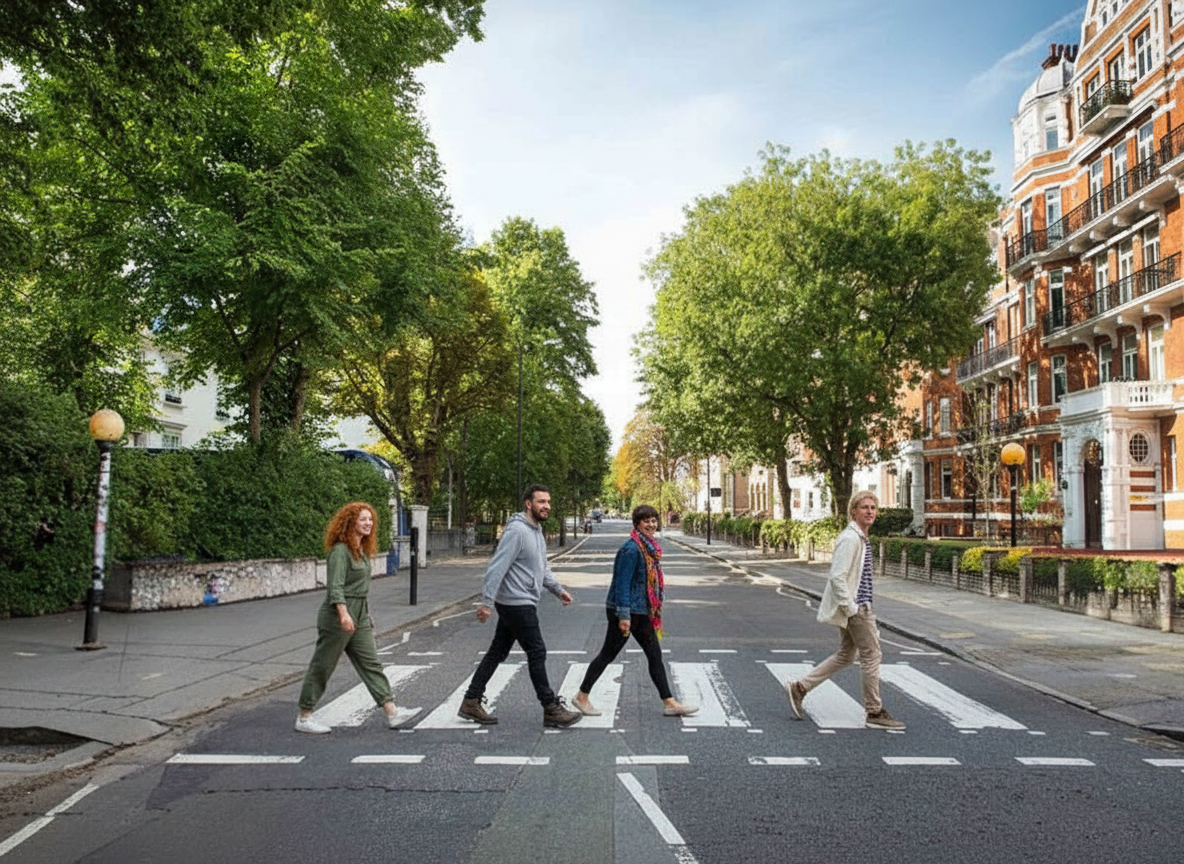
It’s just a zebra crossing on a quiet residential street in St John’s Wood. No gates, no velvet ropes, no ticket office. And yet it might be the most photographed pedestrian crossing in the world.
The crossing itself isn’t the point, of course. Abbey Road Studios is. This is where the Beatles recorded virtually their entire catalogue, from “Please Please Me” in a single marathon session in February 1963 to the “Abbey Road” album that gave the street its fame in 1969. The studio was built in 1931 and the Beatles started recording there in 1962. What happened between those dates changed popular music permanently.
But the Beatles weren’t the only ones. Pink Floyd recorded “The Dark Side of the Moon” here. The orchestral score for the Star Wars films was recorded here. Adele, Radiohead, Oasis, Kanye West — the studio’s client list reads like a hall of fame of the last century of music.
You can’t go inside (it’s still a working studio), but you can walk across the crossing and sign the wall outside. Our drivers will time the visit so you can get a clear photo without holding up traffic for too long. Every cabbie who does this tour has perfected the art of stopping in exactly the right spot.
Montague Square — Lennon, Hendrix and a lot of history
This quiet Georgian square in Marylebone has an absurd amount of musical history for such a small space. Ringo Starr had a flat here in the mid-1960s. He lent it to Paul McCartney, who used it to write songs. Then he lent it to Jimi Hendrix, who lived there with his manager Chas Chandler. Then John Lennon and Yoko Ono moved in, and it was in this flat that the infamous “Two Virgins” album cover was photographed.
Oh, and the flat was also raided for drugs by the police in 1968, leading to Lennon’s arrest — an event that would later cause him years of immigration problems in the United States.
All of that. One flat. One square.

Savile Row — the last gig
On 30 January 1969, the Beatles climbed onto the roof of 3 Savile Row — the headquarters of their Apple Corps company — and played their last ever live performance. It lasted 42 minutes before the police shut it down following noise complaints from neighbouring businesses. The footage became part of the “Let It Be” documentary.
The building is still there. It’s a tailor’s shop now, which is fitting for Savile Row. There’s a small plaque. Stand on the pavement outside and look up, and you’re looking at the spot where John Lennon said “I’d like to say thank you on behalf of the group and ourselves and I hope we passed the audition.”
Carnaby Street and the Soho scene
In the 1960s, Carnaby Street was the centre of the world. Or at least it felt that way. The mods, the rockers, the Beatles, the Stones, the Who — everyone came here for the clothes, the clubs and the energy of a city that was suddenly, explosively creative.
The Marquee Club on Wardour Street (now demolished and rebuilt elsewhere) launched the Rolling Stones, the Who, Led Zeppelin, Jimi Hendrix and dozens of others. Ronnie Scott’s jazz club on Frith Street has been going since 1959 and is still open — Hendrix played his last public performance there in September 1970, three days before he died. The 2i’s Coffee Bar on Old Compton Street is where Tommy Steele and Cliff Richard were discovered in the late 1950s, effectively launching British rock and roll.
Soho is still alive with music. It’s smaller, scrappier and a lot more expensive than it was in the 60s, but the spirit is there if you know where to look.
Brixton — Bowie’s birthplace and beyond
David Bowie was born at 40 Stansfield Road, Brixton, on 8 January 1947. He lived there until he was six, when his family moved to Bromley. Decades later, after his death in January 2016, a mural appeared on the wall of Morley’s department store opposite Brixton tube station. It shows Bowie in his Aladdin Sane guise — the lightning bolt across the face — and has become one of London’s most visited and photographed pieces of street art.
Brixton itself has a long musical history beyond Bowie. The Clash referenced it. The Brixton Academy (now the O2 Academy Brixton) has been one of London’s best live music venues since 1929. The neighbourhood’s Caribbean community brought reggae, ska and sound system culture to south London, influencing everything from punk to jungle to grime.
Freddie Mercury, Jimi Hendrix and the rest
The list goes on. Freddie Mercury lived at 1 Logan Place in Kensington — fans still leave flowers and messages on the wall outside. Jimi Hendrix’s flat at 23 Brook Street in Mayfair is now a museum, and by remarkable coincidence, it’s right next door to the house where Handel lived in the 1720s. Two of music’s greatest innovators, separated by 240 years and a party wall.
The Sex Pistols formed above a shop at 430 King’s Road, Chelsea, in 1975. Malcolm McLaren’s SEX boutique was downstairs. The 100 Club on Oxford Street hosted the first international punk festival in 1976. The Roundhouse in Camden has been a venue since 1966 when Pink Floyd played there. The Dublin Castle in Camden was where Madness were discovered. Denmark Street — London’s Tin Pan Alley — was where the Stones, Elton John and the Kinks all recorded early material in tiny studios that charged by the hour.
Every neighbourhood in London has a musical story. Every street has something. You just need someone to point it out.
Book the Rock & Roll London Tour — 4 hours, £299 per cab, up to 6 guests. Abbey Road, Carnaby Street, Brixton, Savile Row and everywhere in between. Your cabbie provides the soundtrack stories.

Latest Tour News & Facts
London At Night: The Best Landmarks to See After Dark
London With Kids: A Family-Friendly Sightseeing Guide
What Makes London Cabbies the Best Tour Guides in the World
A Wheelchair-Friendly Sightseeing Guide
Changing of the Guard: Insider Tips
Ready to see London the way it was meant to be seen? Jump in a classic black cab and let our expert cabbies take you on the tour of a lifetime. Private tours, historic landmarks, and memories you'll never forget.
Also available on Viator • GetYourGuide • TripAdvisor